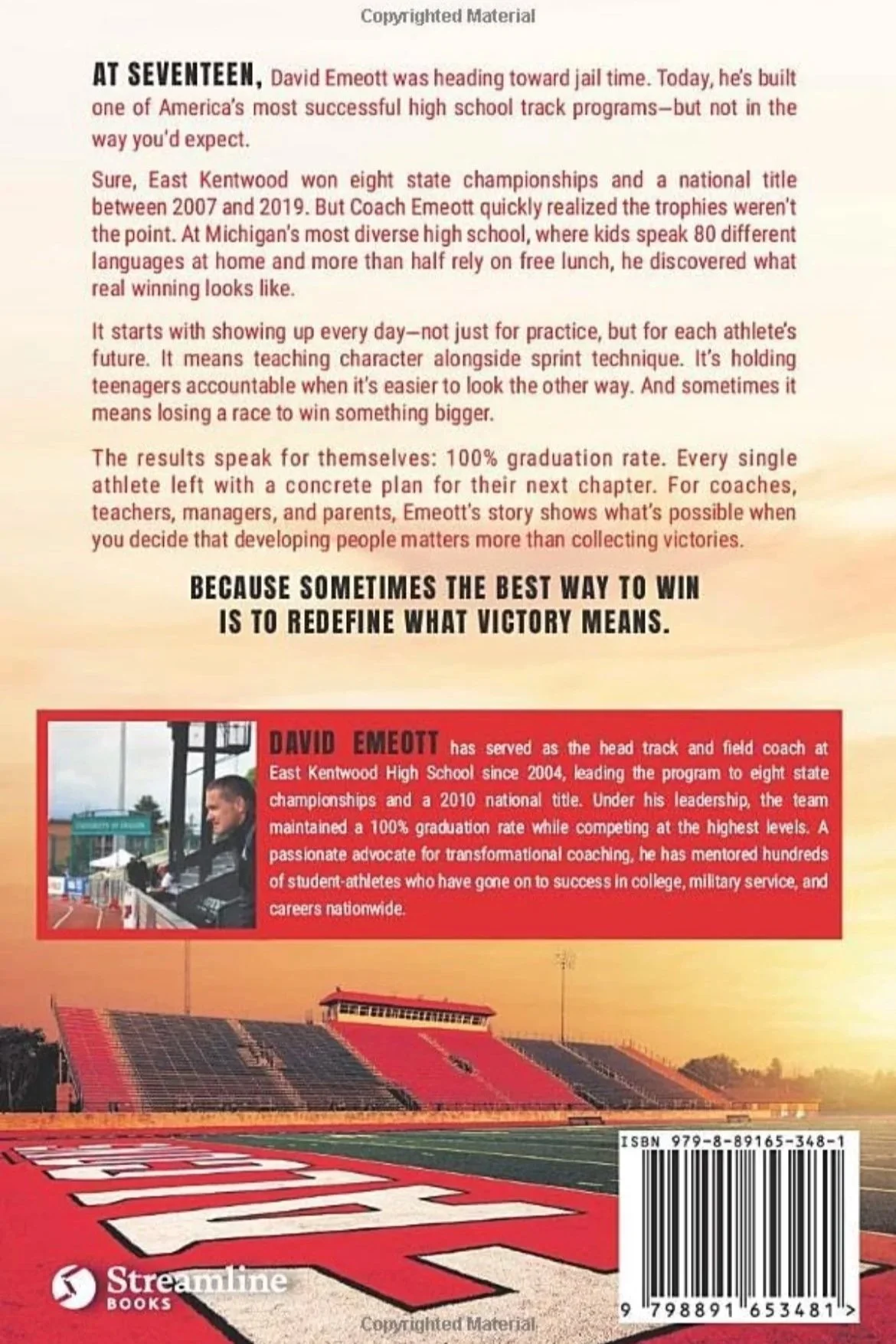
Building a Championship Culture
From 2007 to 2019, East Kentwood High School track and field dominated the sport in the state of Michigan and competed regularly on the national stage, including winning a national championship in 2010. In that thirteen-year stretch, we earned eight state titles and three runner-up finishes, an accomplishment any program would be proud of.
But this book isn’t about winning.
It’s about why we won and how transformational coaching shaped our athletes, our team culture, and the people they became beyond the track.
This book is about character, perseverance, and the lessons I’ve learned along the way. It’s not just a story of victories but one of transformation and purpose. It is my hope that coaches will see this book as a window into a program that experienced both success and struggles. Coaching is hard—it often comes with little reward or praise and, for most high school coaches, even less money.
I hope every coach prioritizes the development of their athletes as people first. Transformational coaching will win in the long run, both on and off the field. Conversely, transactional coaching may lead to short-term success, but it rarely leaves a lasting impact on a student’s life.
Transformational Coaching
My coaching journey began with high hopes and dreams of where my teams would end up and what they could accomplish. In hindsight, we were trying to win things back then we had no business believing we could win. But decades later, after all the trophies and championships, the thing I am most proud of is that our program became transformational for hundreds of young adults.
At the time, we didn’t know the terminology—the differences between “transactional” and “transformational” coaching—but we did know that we wanted to change lives and use athletics as the vehicle to do it. This book will take you on a journey through the highs and lows of athletics during our pursuit. Looking back, there were times when we were transactional, which brought short-term success, and times when we were transformational, where we may have failed in the short term but won in the long run.
Transformational does not mean being weak or soft. In fact, it is often quite the opposite. Being transformational means putting the athlete first in every situation, prioritizing their future above all else. Many times, coaches are faced with the opportunity of letting poor behavior slide for the sake of winning. Choosing this option is transactional, as if asking the athlete, “What can you do for me today?” Transformational coaching, on the other hand, asks, “How will my decision impact you as a person long term?”
In this book, we will explore that journey. Wins and losses come and go, but the character our former athletes have displayed is truly what defines success.
First-Time Head Coach
In 2001, I was named the head cross-country coach at East Kentwood High School, also known as “EK,” and, in 2004, I became the head track and field coach. In those roles, I fully believed we could do things that had rarely been accomplished in West Michigan. At that time, only two West Michigan teams had ever won a Division 1 state title: Traverse City Central, coached by the legendary John Lober, and Portage Central, led by Bill Fries, an amazing coach and mentor to me. I’ve often reflected on what was different prior to West Michigan teams starting to compete with the best in the state. Were our goals too small back then? Did we fail to push one another enough? If “iron sharpens iron,” maybe the west side of the state simply didn’t have enough iron to go around in those days.
Now, things are different: West Michigan teams are consistently competitive with programs from the greater Detroit area. But when I started, winning a conference or regional title was a major accomplishment—and winning a state championship in track and field nearly unheard of.
To reach that level, I knew we’d need to work hard, but sustaining greatness over time would require more than talent. It would take a consistent plan focused on character education, a high-quality staff of coaches, and, overall, a fully transformational approach.
Building Character
If true greatness means more than just winning track meets, then we had to focus on what truly mattered: growing great people within our program. That meant building character and holding athletes accountable for all of their actions, on and off the track. Toward this end, I began designing daily character lessons. We met for practice every day at 2:45, beginning with a character lesson, many of which you’ll find in this book. These lessons covered everything: how to shake hands, meet people, treat officials, respect elders, and more.
Each talk was tailored to the needs of our students. If an issue arose, we’d adjust the lessons to accommodate it. For example, if a team member had stolen something, we’d discuss integrity under the following assumption: “If you lie, you cheat. If you cheat, you steal.” I’d ask my team, “Why don’t most sixty-five-year-olds steal from each other?” The obvious answer would be that, by the time you are sixty-five, you have matured and realized all of your actions have consequences not only for yourself but for others.
These discussions created thought-provoking moments. For sixteen-year-olds, it was a chance to sit quietly and focus, free from distractions like cell phones. I often reiterated: “This is a character lesson. They say losing builds character, but we have no plans to lose, so we need to take this time to learn.”
East Kentwood High School: A Place Like No Other
East Kentwood High School, the home of the Falcons, stands as one of the most vibrant and diverse communities in the country. We are proudly recognized as the most diverse high school in Michigan and consistently rank among the top ten most diverse schools in the United States.
When I talk about diversity, I mean it in every sense of the word—racial, cultural, linguistic, religious, and socioeconomic. On any given day, over eighty languages are spoken in our hallways. We serve nearly three thousand students in grades 9 through 12, making us the largest high school in Michigan. Our student population reflects an extraordinary cross section of the world. We have students who drive BMWs to school and others whose families do not own a car. Roughly 74 percent of our students come from minority backgrounds, and over 55 percent qualify for free or reduced-price lunch, indicating significant economic need.
These challenges are real. Many of our students face daily stressors related to poverty, food insecurity, or unstable housing. As a result, school often becomes more than just a place to learn—it becomes a place of safety, structure, and hope. Teachers and coaches at EK frequently serve not only as educators but also as mentors, role models, and even parental figures.
Despite these barriers, EK is defined not by hardship but by resilience and opportunity. Our staff, families, and community partners work tirelessly to support student success, both academically and personally. While we continue to address achievement gaps—especially in areas like math—we do so with the unwavering belief that all students can thrive when they are seen, supported, and held to high expectations.
East Kentwood isn’t just a high school. It’s a global community under one roof, and it’s a place where greatness is pursued daily by students and staff alike.
In 2007, East Kentwood placed second at the Michigan High School Athletic Association (MHSAA) state meet, the highest finish in school history. We were runners-up again in 2008. Finally, in 2009, we won the state title.
In 2010, our team of 125 boys won the MHSAA state title, the New Balance Nationals title, and was ranked the number one team in the nation by Nike. By the time the pandemic hit in 2020, East Kentwood had won eight state titles, achieved three runner-up finishes, and set multiple all-time state records. We’ve had the privilege of sending many student-athletes to colleges all across the country. But what I’m most proud of is this: We achieved a 100 percent high school graduation rate for our track and field athletes—and nearly every one of them left with a clear postgraduation plan, whether it was college, military service, trade school, or the workforce.
It was our mission to ensure that no student left our program without a direction toward the next chapter of their life.
At times, we were criticized for encouraging some students to pursue college even when others believed they weren’t quite ready. We accept that criticism, but we also know the full story: Many of those same young people started at a local community college, gained confidence, and a few years later were working in careers they never imagined possible.
Yes, some struggled. Some found the academic demands too high or realized they weren’t mature enough for the full college experience. But even in those cases, I know this: They had an opportunity, one that many in their families never had. And even if they didn’t finish college, they began shaping a new narrative of academic achievement for their families.
I can’t count how many times former athletes have brought their own children back to me and proudly said, “Coach, look how smart they are—not like me.” It may be a bittersweet statement as well as a point of pride for them, but either way, I do know this: We’re moving the ball forward one generation at a time.